AC repair
Understand the current cooling problem before weighing a replacement proposal.
Learn more
AC installation and replacement
Brody Pennell offers air-conditioning installation and replacement in Los Angeles. A new outdoor unit is only one part of a replacement. Equipment capacity, indoor components, duct condition, electrical service, controls and the space available for installation can all shape the project.
Start with the comfort problem you want to address and the details of the existing system. If it still cools, compare a repair assessment with a replacement proposal rather than assuming a particular age or symptom makes replacement necessary. If you do replace it, ask how the proposed equipment and installation fit the building, not just how many tons or which efficiency label appear on a quote.
Select replacement equipment for the building's cooling load rather than copying the old unit's rating. ACCA's Manual J covers residential load calculations, and its Manual S covers residential equipment selection. These provide a basis for choosing capacity.
Ask which building details informed the calculation, including planned changes to insulation, windows or room use. Oversized and undersized equipment can affect comfort differently, so the project needs an assessment rather than a guess based on the previous unit.
Request the design basis for the proposed capacity. A replacement recommendation should not rely on the previous unit's size alone.
Ask how the selected indoor and outdoor equipment work together and which model and capacity are included in the proposal.
Central air uses supply and return ducts to move conditioned air. ENERGY STAR's quality-installation guidance calls for evaluating ducts and checking airflow against manufacturer specifications. Ask whether existing ducts suit the selected equipment or need work.
Ask where the equipment will sit, how technicians can access it, and what work is needed for controls, condensate handling or connections. A new unit may not fix uneven room temperatures if the cause is airflow or duct distribution.
Ask whether duct sizing, return air, supply registers, sealing and insulation were reviewed, and which duct work is included.
Confirm equipment placement, service access and any electrical or structural work that may be needed at the property.
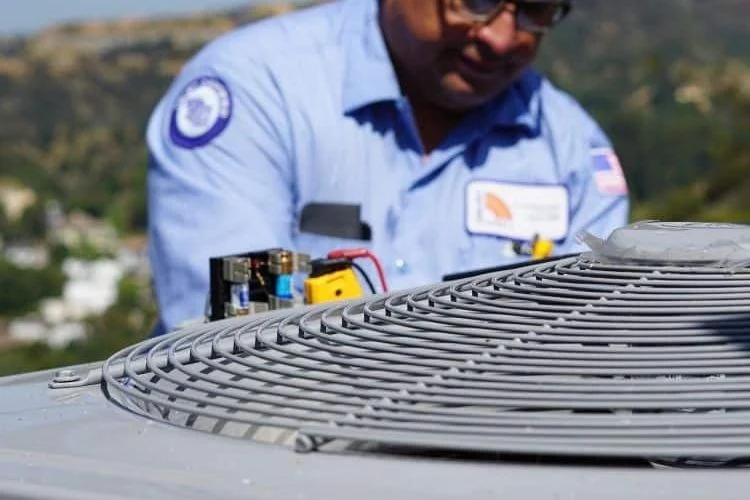
If the current AC has a problem, ask what inspection supports the repair recommendation. Compare the fault, scope, system condition, repair history and parts availability. Age or one symptom alone does not decide between repair and replacement.
If considering replacement, request a written scope that identifies equipment, sizing, compatibility with indoor components and ducts, and related work. Confirm price, any project charges and applicable terms before authorizing work.
Review equipment, labor, duct or electrical work, exclusions and start-up checks across proposals.
Ask what the proposal includes, excludes or leaves as an allowance. Confirm equipment model and capacity, compatibility, controls, duct or electrical work, condensate routing, old-equipment removal and start-up checks.
Permit and plan-review requirements depend on the work and jurisdiction. LADBS lists mechanical HVAC categories requiring plan check before permit issuance. Ask which rules apply and who will obtain approvals; this page does not set a project-specific threshold.
Ask who will coordinate inspections or approvals when they apply, and what records you will receive after installation.
AC installation and replacement
ACCA's Manual J covers residential load calculations, and its Manual S covers residential equipment selection. Ask what building details informed the proposed capacity and how the selected equipment matches the calculation.
Sometimes, but their sizing, condition, sealing, insulation and airflow should be considered with the new equipment. Ask which duct checks were completed and whether any repair or modification is included in the proposal.
Compare the diagnosed fault and repair scope with the system's condition, repair history and parts availability. If replacement is an option, request a separate proposal that explains sizing, equipment compatibility and site work.
The indoor and outdoor equipment must be assessed for compatibility, and the ducts, controls and installation conditions also matter. Ask the contractor to identify the complete equipment combination and any related work in writing.
Permit and plan-review requirements depend on the work and jurisdiction. LADBS identifies specific categories of mechanical HVAC installations that require plan check before a permit is issued. Ask which rules apply to the exact project.
Heating and air conditioning
Understand the current cooling problem before weighing a replacement proposal.
Learn moreExplore heating maintenance and replacement considerations for your property.
Learn moreLearn how filtration, source control and ventilation relate to HVAC decisions.
Learn moreRequest service
Share the service address, existing system details you can access safely and the comfort concern you want to address. A request is not a confirmed appointment.
Prefer to talk about your system?
(310) 810-2721